

How to Store Freeze Dried Candy: Keep It Crunchy
Table of Contents
- Why Freeze Dried Candy Goes Stale So Fast
- How to Store Freeze Dried Candy: Step-by-Step
- Best Containers for Freeze Dried Food (and Candy)
- How to Prevent Moisture in Freeze Dried Candy
- Freeze Dried Candy Shelf Life: What to Expect
- Common Storage Mistakes and How to Avoid Them
- Frequently Asked Questions
Last Updated: September 20, 2026
Why Freeze Dried Candy Goes Stale So Fast
Freeze dried candy goes stale fast because it is hygroscopic, meaning it pulls moisture straight out of the air. That same airy crunch you love is the result of almost all water being removed during the freeze-drying process. Once that candy meets humidity, it starts soaking it back up like a sponge.
The Science of Hygroscopic Candy
Hygroscopic means a material absorbs water from its surroundings. Freeze-dried candy is extremely hygroscopic because of all the tiny air pockets left behind when ice turns to vapor during processing.
How Humidity and Temperature Speed Up Spoilage
Warm, humid air is the enemy. Heat speeds up the moisture transfer, and humidity gives the candy something to absorb.
- High humidity softens the candy within hours
- Warm rooms make the process faster
- Direct sunlight adds heat and light damage
- Temperature swings cause condensation inside containers
USDA food storage and safety guidance
How to Store Freeze Dried Candy: Step-by-Step
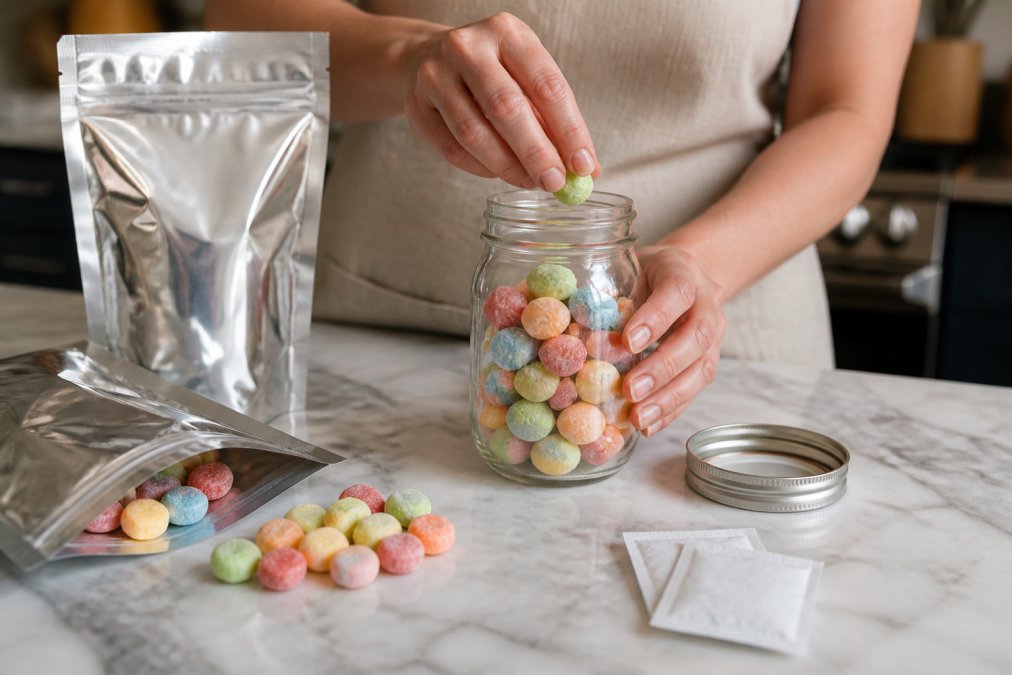
You can store freeze dried candy for months by sealing it airtight, adding an oxygen absorber, and keeping it cool, dark, and dry. Here is the exact process to follow.
Step 1: Check Seal Integrity Before Anything Else
Squeeze the original bag gently. If it feels soft or you hear air moving, the seal has failed. Move that candy into a new container right away.
Step 2: Choose Your Container and Add Oxygen Absorbers
Move candy into a food-grade container with a tight seal. Add an oxygen absorber packet to slow oxidation. For long-term storage, a Mylar bag with a heat seal beats almost anything else.
Step 3: Find the Right Spot in Your Home
Store your containers in a cool, dark cabinet away from the stove, dishwasher, and windows. A steady ambient temperature matters more than a cold one.
Best Containers for Freeze Dried Food (and Candy)
The best containers for freeze dried food are Mylar bags with oxygen absorbers for long-term storage and glass Mason jars for short-term storage. Both block moisture well when sealed correctly. The difference between a container that works and one that fails usually comes down to three things: the moisture vapor transmission rate of the material, how much headspace you leave, and whether the seal is actually airtight.
| Container | Best For | Moisture Barrier | Reusable |
|---|---|---|---|
| Mylar bags + heat seal | Long-term storage | Excellent | No |
| Mason jars | Short-term storage | Very good | Yes |
| Vacuum-sealed bags | Medium-term storage | Very good | No |
| Original sealed pouch | Immediate use | Good until opened | No |
Why Headspace Matters More Than Container Brand
Every container holds a pocket of air above the candy. That air carries moisture, and the candy will pull it in until the two reach equilibrium. The more headspace you leave, the more moisture the candy has to absorb before it stabilizes. Fill Mylar bags and jars to within about an inch of the top, then seal.
How to Test a Seal Before You Trust It
Most storage failures happen because a seal looked fine but was not. Here is a simple batch test you can run before committing a whole order to long-term storage:
- Seal a small sample from each batch in its own bag or jar.
- Press the container gently. A good seal holds firm; a bad one flexes or hisses.
- For Mylar, run a fingernail along the heat-sealed seam and look for wrinkles, gaps, or pinholes.
- For Mason jars, check that the lid has pulled down and does not pop when pressed.
- Wait two weeks, then open the sample. If it is still crisp, your method works. If it has gone soft, change the container or the location before the rest of the stash follows.
Reusing Containers Safely
Glass Mason jars and resealable Mylar bags can be reused, but only if the seal is still intact. Wash glass jars with hot soapy water, dry them completely, and inspect the rim for chips. A chipped rim will not seal. Mylar bags can be reused if the original heat seal is cut off cleanly and there is enough material left to seal again.
FDA guidance on food contact substances and food-grade materials
How to Prevent Moisture in Freeze Dried Candy
You prevent moisture in freeze dried candy by combining a moisture barrier, a desiccant, and smart placement. No single step is enough on its own.
Desiccant Packets and Vacuum Sealing
Desiccant packets absorb stray moisture inside a container. They are not a replacement for a good seal, but they buy you extra time.
Climate-Specific Storage Advice
Where you live changes your approach. This is the part most guides skip.
- Humid climates: Double-bag everything. Use Mylar plus a desiccant, and never open containers outdoors.
- Dry climates: A single airtight container usually holds up well. Watch for temperature swings instead.
- Coastal areas: Salt air and humidity together are tough. Keep candy sealed and store it away from open windows.
- High-altitude areas: Lower air pressure can stress seals. Check seal integrity more often.
Freeze Dried Candy Shelf Life: What to Expect
Freeze dried candy shelf life runs roughly one to two years when stored properly in an airtight container, and often just a few weeks once the seal is broken. The candy itself stays safe far longer than it stays crunchy.
Why Sugar Content Changes the Clock
Not all freeze-dried candy ages at the same rate. The biggest variable is how hygroscopic the candy is, and that depends on its sugar and fat profile.
- Hard sugar candies (lollipops, sour hard candy, taffy-style chews): Crystalline sugar holds its structure well and resists moisture longer. These are the slowest to soften.
- Gummy-based candies (gummy bears, fruit chews): Gelatin and pectin networks trap moisture differently and tend to go chewy before they go soggy.
- Chocolate-covered or coated candies: Fat and cocoa solids absorb moisture and oxidize faster, so these go stale first. A chocolate-covered freeze-dried treat may lose its snap in weeks, not months.
- Candies with a powdered or sour coating: The coating dissolves first, leaving a sticky surface that then pulls in more moisture.
Signs Your Candy Has Gone Bad
Watch for these signals:
- The candy feels soft, chewy, or sticky
- Pieces clump together in the container
- You see visible moisture or fog inside the bag
- The texture turns powdery instead of crisp
- It smells stale or musty
If the candy is just soft, it is still safe to eat. It simply lost its crunch. Soft candy is a texture problem, not a safety problem, because the low water activity that made it shelf-stable in the first place is what kept bacteria from growing.
A Quick Batch Test for Shelf Life
You can estimate how long a batch will last without waiting a year. Seal a small sample from each order separately and check it after two weeks. If that sample stays crisp, your storage method is working. If it goes soft, adjust your container or location before the rest of your stash follows.
Common Storage Mistakes and How to Avoid Them
- Storing candy in the fridge, where condensation forms every time you open the door
- Reusing a bag that already lost its seal
- Skipping oxygen absorbers on long-term batches
- Leaving containers in direct sunlight
- Opening the whole container just to grab a few pieces
- Mixing new candy with old candy in the same jar
Repurposing containers is another easy win. A cleaned Mason jar or a resealable Mylar bag from a previous order works just as well the second time, as long as the seal is still intact.
Frequently Asked Questions
How long does freeze-dried candy stay fresh?
Freeze dried candy shelf life depends on how you store it. In an airtight container with oxygen absorbers kept in a cool, dark spot, it can stay crunchy for 6 to 12 months or longer. Once you open the original bag and expose the candy to air, the clock speeds up. Transfer leftovers to a sealed container right away. Heat, humidity, and direct sunlight all shorten that window, so a pantry shelf away from the stove works better than a countertop near a window.
What is the best container for storing freeze-dried candy?
Mylar bags with a heat seal and oxygen absorbers are the gold standard for long-term storage. For everyday snacking, a Mason jar with a tight-fitting lid or a vacuum-sealed food-grade container works well. The key is a real moisture barrier. Plastic zip-top bags and loosely closed original packaging let humid air in, which turns that crunch soggy within days. Whatever you pick, squeeze out excess air before sealing and store it somewhere cool.
Does freeze-dried candy need to be refrigerated or frozen?
No. Freeze-dried candy is shelf-stable at room temperature, and the refrigerator is actually a bad idea. Every time you open the fridge, warm air hits the cold candy and condensation forms on the surface. That moisture is exactly what you are trying to keep out. The freezer works only if the candy is vacuum-sealed and you let it sit unopened until it reaches room temperature. For most people, a cool, dry pantry shelf is the simplest and safest choice.
How do I know if my freeze-dried candy has gone bad?
Texture tells you first. Fresh freeze-dried candy shatters when you bite it. If it bends, chews like taffy, or feels soft, moisture has gotten in and the crunch is gone. Flavor dulls next, turning flat or bland instead of bright and intense. Visible clumping or sticky patches mean heavy moisture exposure. It is not unsafe to eat at that point, but it will not deliver the experience you paid for. Toss it or use it as a topping on ice cream.
Freeze-dried candy rewards good habits. Seal it airtight, keep it cool and dark, and it stays crunchy for months instead of days. Kelly's Pantry & Pawtry crafts each batch for that exact crunch, with a variety of flavor-packed snacks made to hold up from the first bite to the last. Shop Kelly's Pantry & Pawtry and treat your stash to storage that protects every crisp, flavorful piece.