

Freeze Dried Candy Texture Guide 2026
Table of Contents
- What Freeze Dried Candy Texture Actually Is
- Freeze Dried Candy vs Traditional Candy: Texture and Flavor
- Best Candy for Freeze Drying: Texture Outcomes by Type
- How to Freeze Dry Candy at Home: Steps for Consistent Texture
- Home vs Commercial Equipment: Texture Variance Explained
- Troubleshooting Freeze Dried Candy Texture Problems
- Post-Processing Texture Maintenance: Storage and Shelf Life
- Frequently Asked Questions
Last Updated: September 28, 2026
What Freeze Dried Candy Texture Actually Is
Freeze dried candy texture is the brittle, airy structure left after nearly all moisture is pulled from candy under vacuum, leaving the sugar skeleton behind. At Kelly's Pantry & Pawtry, we call it "crunch that dissolves", it shatters instead of sticking to your teeth.
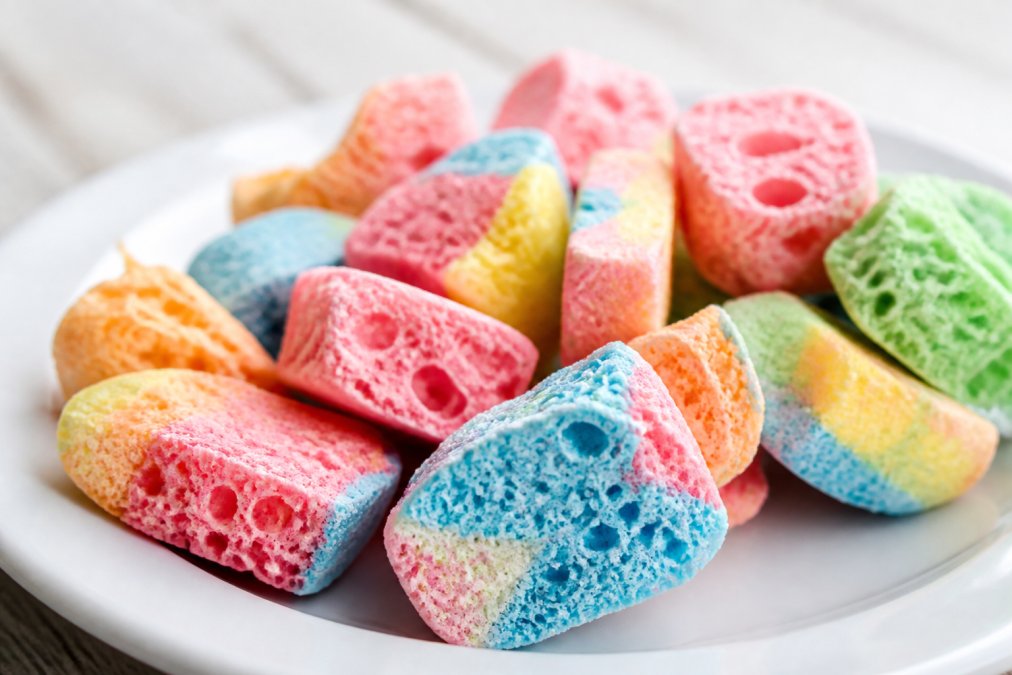
The Sublimation Process and Air Pockets
Sublimation is the phase change where frozen water turns directly into vapor, skipping the liquid stage. In a freeze-drying chamber, candy is frozen, then pressure drops so low the internal ice vaporizes.
Why Candy Puffs Up: Vacuum Pressure and Moisture Removal
Candy puffs because vacuum pressure removes internal moisture faster than the structure can collapse, so the dry sugar matrix holds its expanded shape.
Two variables drive puff:
- Vacuum pressure: Lower pressure pulls vapor out faster, producing a lighter, more expanded piece.
- Cycle duration: A longer cycle gives moisture more time to escape from the center of dense candies.
Freeze Dried Candy vs Traditional Candy: Texture and Flavor
Freeze dried candy and traditional candy differ in nearly every sensory dimension, widest in texture. Traditional candy is dense, chewy, and holds moisture; freeze dried candy is porous, crisp, and shelf-stable.
| Attribute | Traditional Candy | Freeze Dried Candy |
|---|---|---|
| Texture | Chewy, dense, sticky | Brittle, airy, crisp |
| Mouthfeel | Coats the teeth | Dissolves on contact |
| Flavor intensity | Diluted by moisture | Concentrated |
| Shelf life | Weeks to months | Months, if sealed |
| Structural integrity | Flexible | Fragile |
Sensory Profile Comparison: Crunch, Chew, and Mouthfeel
The sensory shift is the headline: traditional candy delivers a lingering chew, while freeze dried candy delivers a snap that disappears the moment it hits saliva. People with braces often find it easier to manage because it dissolves rather than pulling, the same reason parents like a treat that doesn't glue to molars.
Flavor Concentration and Sugar Crystallization
Flavor concentration increases because no water remains to dilute it, every note lands harder and faster. Sugar crystallization also changes: traditional candy keeps sugar semi-liquid, while freeze dried candy re-forms it into a rigid crystalline lattice, shifting the texture from chewy to crunchy.
Best Candy for Freeze Drying: Texture Outcomes by Type
The best candy for freeze drying has high sugar, low fat, and a simple structure, three traits that predict a clean puff and reliable crunch. How common categories perform:
- Gummy candies: Excellent. They expand dramatically and produce a light, brittle crunch.
- Hard candies: Good. They shatter into shards rather than puffing, but flavor concentration is intense.
- Taffy and caramel: Mixed. High fat interferes with moisture removal, so results vary.
- Chocolate-covered items: Poor. Fat melts and separates, leaving a greasy film.
Candies to Avoid: Sticky Messes and Melt-Prone Options
Skip anything high in fat or oil. Chocolate, nut clusters, and oil-based coatings melt and separate in the chamber, leaving a sticky mess on trays. Also avoid candies with a soft, high-moisture center: the shell may dry while the interior stays wet, ruining batch consistency and shortening shelf life.
How to Freeze Dry Candy at Home: Steps for Consistent Texture
Consistent texture comes down to three things: correct tray loading, correct temperature, and a full cycle duration.
Step-by-Step Process: Tray Loading to Cycle Duration
- Freeze the candy first. Spread pieces in a single layer and freeze until solid, usually several hours, to prevent puffing during pump-down.
- Load trays in a single layer. Overcrowding blocks airflow and creates uneven drying.
- Set the temperature. Follow your machine's guidance for candy rather than guessing.
- Run the full cycle. Cutting it short leaves residual moisture, the number one cause of soft texture.
- Check for doneness. A finished piece should shatter, not bend. If it bends, run additional time.
- Cool before packaging. Warm candy pulls moisture from the air, so let it reach room temperature first.
Expected result: A piece that snaps cleanly, feels light, and dissolves without sticking.
Common Mistakes That Ruin Texture
Three errors account for most failed batches:
- Under-drying. Pulling candy early leaves moisture inside, and it goes soft within days.
- Overloading trays. Stacked or touching pieces dry unevenly.
- Packaging too soon. Sealing warm candy traps moisture and undoes the cycle.
Home vs Commercial Equipment: Texture Variance Explained
The texture gap between home and commercial freeze dryers isn't about brand or price, it's how tightly each machine holds three variables: chamber pressure, shelf temperature, and condenser temperature. Those determine how fast ice sublimes, how evenly it leaves each piece, and how large the air pockets become.
Vacuum Pressure and the Puff Mechanism
Sublimation only happens below water's triple point, about 4.6 torr (0.006 atm). Home units pull chamber pressure to roughly 500-1,000 millitorr during primary drying, while commercial cabinets hold 100-300 millitorr and recover faster after each tray load.
Shelf Temperature and Thermal Conductivity
Shelf temperature is the second lever. Home units typically run shelves at 100-130°F during primary drying, then step up during secondary drying to drive off bound moisture. Commercial cabinets hold tighter tolerances, often within a few degrees across the shelf, because radiant heat must travel through the tray into the candy by conduction.
Condenser Capacity and Cycle Recovery
The condenser is the unsung variable: it traps the water vapor the pump pulls from the chamber. A small condenser saturates faster, raising chamber pressure mid-cycle. A large commercial condenser keeps pulling vapor away, so pressure stays low and drying stays even. That's why two machines with identical chamber sizes can produce very different textures, more condenser headroom means a steadier vacuum, and steadier vacuum means more uniform puff.
What This Means for Home Producers
- Run separate cycles per candy type. Gummies, hard candies, and taffy have different moisture loads and durations.
- Rotate trays mid-cycle if your unit has hot spots or uneven shelf contact.
- Watch the pressure gauge, not just the timer. A gauge that climbs during primary drying means the condenser is struggling.
- Accept more piece-to-piece variance for a lower equipment cost.
Troubleshooting Freeze Dried Candy Texture Problems
Most texture problems trace back to one of four causes, each with a specific fix. Use this table to diagnose a failed batch.
| Problem | Likely Cause | Fix |
|---|---|---|
| Chewy, not crunchy | Incomplete moisture removal | Extend cycle duration |
| Crushed into powder | Over-drying or thin pieces | Shorten cycle, use thicker pieces |
| Sticky exterior | Opened chamber mid-cycle | Run full cycle without interruption |
| Soft within days | Packaged while warm | Cool fully, then vacuum-seal |
| Uneven results | Overloaded trays | Single layer, space between pieces |
Post-Processing Texture Maintenance: Storage and Shelf Life
Freeze dried candy is hygroscopic, it pulls moisture from the air. The texture you achieved in the chamber is only as stable as your storage environment, which varies by region and season.
How Humidity Drives Texture Degradation
Ambient relative humidity (RH) is the variable most home producers ignore. The porous sugar matrix left after sublimation has enormous surface area, and every air pocket is a site where water vapor can re-adsorb. The higher the surrounding RH, the faster candy rehydrates from the outside in.
A common pattern reported by home producers:
- Under 30% RH: Candy stays crisp for weeks in a well-sealed bag, even without a desiccant.
- 30-50% RH: A sealed bag with a desiccant packet holds crunch for several weeks; an unsealed bag goes soft within days.
- 50-70% RH: Even sealed bags benefit from a desiccant, and resealing after every opening is essential.
- Above 70% RH: Texture loss is rapid. Vacuum-sealing with a desiccant is the only reliable approach, and even then, opened bags should be finished quickly.
Climate and Seasonal Adjustments
Different regions impose different storage burdens:
- Humid coastal and southern climates: Year-round high RH makes desiccants mandatory. Use larger packets and replace them when the indicator beads change color.
- Arid and high-desert climates: Low RH holds crunch longer, but temperature swings can cause condensation inside sealed containers.
- Seasonal swings: Summer humidity can double or triple winter RH in the same location, so a routine that works in January may fail in July.
- Winter heating: Indoor RH can drop below 20%, ideal for storage, but the dry air makes candy more brittle and prone to shattering during handling.
Packaging That Actually Protects Texture
Not all packaging performs equally against humidity:
- Mylar bags with oxygen absorbers and desiccants: The gold standard for long-term storage; the metallized layer blocks moisture vapor far better than clear plastic.
- Vacuum-sealed bags: Excellent for moisture, but compression can crush fragile pieces. Use a gentle setting or low-pressure chamber sealer.
- Glass jars with gasket seals: Good for short-term display and gifting, but the seal degrades with repeated opening. Add a desiccant packet.
- Resealable stand-up pouches: Convenient but the weakest barrier, fine for candy eaten within a week or two.
The more fragile the piece and the higher your ambient RH, the more you should lean toward mylar with desiccants and away from vacuum compression.
Shelf Life Expectations by Storage Method
| Storage Method | Typical Crisp Window |
|---|---|
| Mylar + desiccant, sealed | Several months to a year |
| Vacuum-sealed, cool and dark | Several months |
| Airtight container + desiccant | Several weeks to a couple of months |
| Resealable pouch, opened | Days to a couple of weeks |
| Left open | Hours to a day |
These windows assume the candy was fully dried to begin with. Under-dried candy goes soft faster than any of these estimates, regardless of packaging.
Handling and Serving
- Pour out what you need, then reseal immediately. Every minute an open bag sits out, it pulls moisture.
- Avoid refrigerating opened bags. Condensation forms when the cold bag returns to room temperature and goes straight into the candy.
- Keep serving bowls small. Candy left out at a party softens within an hour or two indoors.
- Handle gently. The same brittleness that makes the crunch satisfying makes pieces easy to crush. Store with minimal headspace and avoid stacking heavy items on top.
Handled correctly, fully dried, cooled, sealed with a desiccant, and stored away from humidity and heat, freeze dried candy stays shelf-stable for months. The texture you worked for in the chamber is only as good as the seal and the climate you store it in.
Frequently Asked Questions
What candy should not be freeze dried?
Avoid candies with high fat or oil content, like chocolate-covered items, because they do not freeze-dry well and can turn greasy or rancid. Sticky candies such as caramels or taffy also tend to become a sticky mess rather than developing a brittle texture. Candies with a soft, moist center, like some filled chocolates, often collapse or fail to puff up properly. For best results, stick to hard candies, gummies, and chewy sweets that are low in fat and moisture.
Why does candy get bigger when freeze-dried?
During freeze-drying, the candy is frozen and then placed in a vacuum chamber. The low pressure causes the frozen water inside to sublimate, turning directly from ice to vapor without becoming liquid. As the water vapor escapes, it leaves behind air pockets, which makes the candy expand and become lighter. This puffing effect is what gives freeze-dried candy its signature airy consistency and brittle texture.
How does the texture of freeze-dried candy differ from traditional candy?
Traditional candy is often hard, chewy, or sticky, while freeze-dried candy becomes crispy, crunchy, and light. The freeze-drying process removes moisture, creating a porous structure filled with air pockets. This results in a brittle texture that melts in your mouth rather than sticking to your teeth. The flavor also becomes more concentrated because the sugars and flavorings are left behind in a more compact form, intensifying the taste.
Does freeze-drying change the flavor intensity of candy?
Yes, freeze-drying typically intensifies the flavor. When moisture is removed, the remaining sugars, acids, and flavor compounds become more concentrated. This means a piece of freeze-dried candy often tastes sweeter or more sour than its original counterpart. However, if the process is not done correctly, some flavors can become muted or bland. Proper cycle duration and temperature settings are key to preserving and enhancing the original taste.
What are the best freeze dry settings for Jolly Ranchers?
Jolly Ranchers are a popular choice for freeze-drying because they puff up beautifully and develop a crispy texture. A standard cycle typically involves freezing the candy first, then running the freeze-dryer according to the manufacturer's instructions for hard candy. Most home units have preset cycles that work well. The key is to ensure the candy is completely dry; if it feels chewy or sticky after the cycle, it needs more time. Always follow your machine's guidelines for temperature and duration.
How do I keep freeze-dried candy crunchy after opening?
Freeze-dried candy is hygroscopic, meaning it absorbs moisture from the air. To maintain its crispy texture, store it in an airtight container or a vacuum-sealed bag immediately after opening. Keep it in a cool, dry place away from humidity. Adding a desiccant packet can help extend shelf life. If the candy starts to soften, you can refresh it by placing it back in the freeze-dryer for a short cycle, but this may affect the texture slightly.