

Is Freeze-Dried Candy Safe for Braces? A 2026 Guide
Table of Contents
- How Freeze-Dried Candy Changes Texture (And Why It Matters for Braces)
- Is Freeze-Dried Candy Actually Safe for Braces?
- Foods to Avoid With Braces: What Your Orthodontist Wants You to Skip
- How to Test If a Freeze-Dried Candy Is Safe to Eat
- How to Clean Braces After Eating Candy
- DIY vs. Commercial Freeze-Dried Candy: Quality and Safety Differences
- Frequently Asked Questions
Last Updated: September 27, 2026
How Freeze-Dried Candy Changes Texture (And Why It Matters for Braces)
Whether is freeze dried candy safe for braces depends on texture, because freeze-dried candy is regular candy with nearly all its water removed through a low-temperature vacuum process, leaving a light, airy, often brittle structure. At Kelly's Pantry & Pawtry, we explain this texture shift because it affects how the candy behaves against orthodontic appliances.
The Sublimation Process Explained Simply
Sublimation is when frozen water turns directly into vapor without a liquid stage (The Water Cycle). In candy production, ice crystals inside a frozen piece of taffy become gas and escape, leaving tiny air pockets behind.
Why Some Freeze-Dried Candies Stay Hard and Others Turn Airy
Not all freeze-dried candies behave the same way. Final texture depends on the original candy's sugar content, density, and pre-freezing water content.
- High-moisture candies like taffy and gummies tend to become very airy and light after freeze-drying
- Low-moisture hard candies often stay dense and glassy, sometimes becoming harder than the original
- Chocolate-based candies can turn chalky or crumbly because their fat content doesn't sublimate the same way water does
Is Freeze-Dried Candy Actually Safe for Braces?
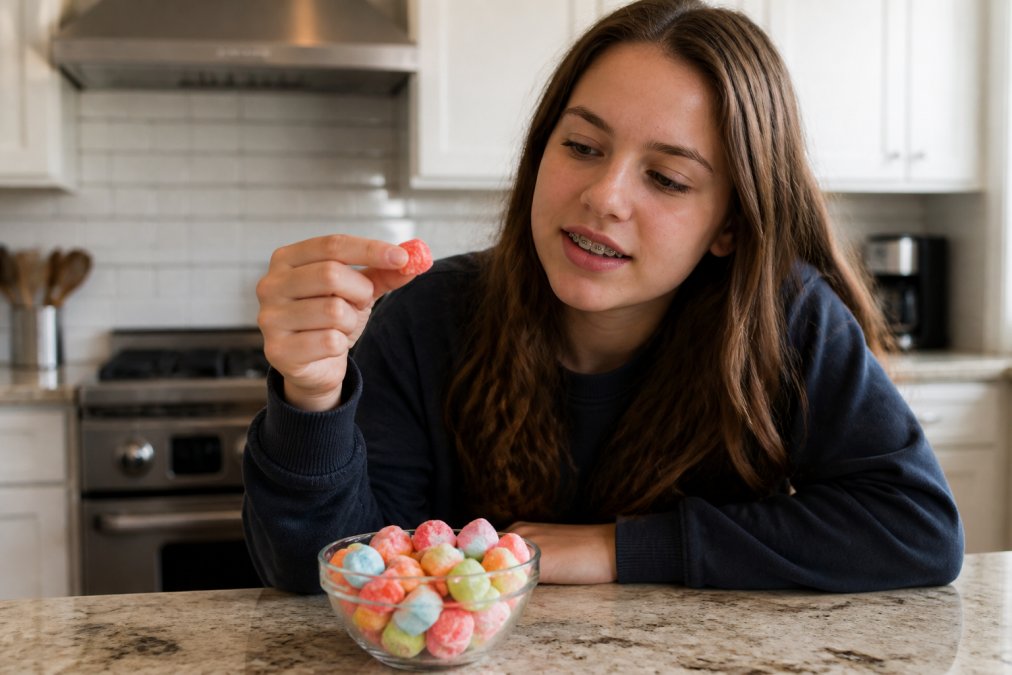
The short answer: it depends on the specific candy and how you eat it. Freeze-dried candy is not automatically safe for braces, but it's not automatically dangerous either. The deciding factors are crunch factor, piece size, and whether it shatters into sharp fragments.
The Crunch Factor: How Much Chewing Pressure Is Too Much?
Bite force is the pressure your jaw generates when you bite down, for most adults, enough to crack a hard candy shell. For braces wearers, the concern is whether that force transfers to your brackets and archwires.
Bracket Detachment Risk and Mechanical Stress
Bracket detachment happens when the bonding material between bracket and enamel fails, from a single hard impact or repeated smaller stresses over time.
Foods to Avoid With Braces: What Your Orthodontist Wants You to Skip
Most braces food lists stop at "no hard candy, no taffy, no popcorn." That's correct but incomplete, because it treats every food as a single texture instead of ingredients that behave differently once they hit saliva, chewing force, and orthodontic adhesive. The useful question is not what to avoid but which ingredient mechanism makes a food risky.
The Three Failure Modes That Actually Break Orthodontic Appliances
Bracket and wire failures trace to three mechanisms:
- Concentrated point force. A hard, dense piece delivers all its load to one bracket or wire segment. Hard candy, nut skins, and popcorn kernels are the classic offenders. The bracket doesn't need to be hit hard, it needs to be hit narrowly.
- Adhesive shear and peel. Sticky foods grab the bracket and pull sideways, the direction orthodontic adhesive is weakest against. Taffy, caramel, and rehydrated gummy residue are the main culprits.
- Repeated micro-loading. Chewy but not sticky foods, dense gummies, some protein bars, thick dried fruit, flex the archwire over and over. This is the slowest failure mode, usually noticed only when a wire has already bowed out of the bracket slot.
Freeze-dried candy can land in any of these three categories depending on its original recipe, which is why "is freeze-dried candy safe for braces" has no single answer.
Ingredient-by-Ingredient Risk After Freeze-Drying
Freeze-drying removes water but not sugar, fat, gelatin, or corn syrup solids, and those ingredients determine what the candy does inside your mouth.
- Corn syrup and invert sugar. The backbone of taffy, gummies, and most chewy candy. After freeze-drying they form a glassy, hygroscopic matrix that pulls moisture out of the air and your saliva. A freeze-dried taffy that starts brittle can turn tacky within seconds of touching your tongue, the dangerous stage for brackets, because it behaves like the original taffy.
- Gelatin and pectin. These set the chew structure in gummies. Freeze-dried gelatin candy shatters cleanly when dry, but the shards are irregular and can wedge under a wire or between a bracket and the gum line. Gelatin also rehydrates fast, so a lodged shard can soften and cling.
- Cocoa butter and other fats. Fat does not sublimate like water, so chocolate-based freeze-dried candy often ends up chalky or crumbly rather than airy. The crumbs are small and low-force, which is favorable, but they melt into a sticky film that coats brackets and wires and is hard to rinse away.
- Crystalline sugar (sucrose, dextrose). This is what makes hard candy hard. Freeze-drying a low-moisture hard candy can actually increase its perceived hardness because there is no residual water to soften the crystal lattice. These behave most like traditional hard candy and carry the highest bracket risk.
The Foods List, Reframed by Mechanism
| Food category | Primary failure mode | Why it matters with braces |
|---|---|---|
| Hard candy, lollipops, dense freeze-dried hard candy | Concentrated point force | Can pop a bracket or chip enamel on a single bite |
| Taffy, caramel, rehydrated freeze-dried chews | Adhesive shear and peel | Pulls brackets sideways, the weakest direction for orthodontic adhesive |
| Nuts, popcorn kernels, ice | Concentrated point force | Unpredictable shapes deliver force to unexpected spots |
| Whole apples, raw carrots, corn on the cob | Concentrated point force on front teeth | Front brackets and wires take the load directly |
| Dense gummies, thick dried fruit | Repeated micro-loading | Slowly flexes and bows the archwire |
| Airy freeze-dried candy that crumbles at finger pressure | Low, fragments are small and low-force | Generally the safest freeze-dried option, but still requires post-eating cleaning |
Where Freeze-Dried Candy Actually Sits
The question of is freeze dried candy safe for braces has no single answer, because freeze-dried candy is not a single food but a process applied to many base candies, and the base candy decides the risk. A freeze-dried saltwater taffy and a freeze-dried hard lemon drop are both "freeze-dried candy," but they fail in completely different ways against braces.
How to Test If a Freeze-Dried Candy Is Safe to Eat
Testing a freeze-dried candy takes about ten seconds and can save a bracket repair appointment:
- Squeeze test: Press a piece between your thumb and index finger. If it crushes easily, it's likely safe.
- Snap test: Try to break a piece with your hands. If it snaps cleanly into small fragments, the crunch factor is manageable.
- Size check: Break larger pieces into pea-sized chunks. Never eat a whole piece in one bite.
- Moisture check: If the candy feels tacky or soft, it may have absorbed moisture and become gummy, which is worse for braces than brittle.
- Dissolve test: Place a small piece on your tongue. If it dissolves rather than requiring chewing, that's ideal.
How to Clean Braces After Eating Candy
Most cleaning advice for braces assumes a bathroom sink and unlimited time. That's not how candy gets eaten, freeze-dried candy is a snack food, eaten at a movie, in a car, between classes, and its residue differs from a normal meal's. Understanding that residue separates a routine that prevents white spot lesions from one that just feels thorough.
What Freeze-Dried Candy Residue Actually Is
Eating freeze-dried candy leaves three things on your brackets, wires, and enamel:
- Sugar film. Dissolved sugar coats every surface it touches, including the underside of brackets and the space between the bracket base and the tooth. This invisible film is the primary food source for decay-causing bacteria.
- Starch and corn syrup solids. Stickier than plain sugar and resistant to a simple water rinse, the reason a quick swish is not enough after freeze-dried taffy or gummies.
- Gelatin or pectin fragments. Small pieces of rehydrated gummy can lodge under wires or between teeth, sit for hours, and are the ones most likely to be missed.
Why White Spot Lesions Are the Real Concern
A white spot lesion is the earliest visible stage of tooth decay, a chalky, opaque patch on enamel, usually at the gum line or around a bracket. Orthodontists see them constantly in braces patients, because brackets create a sheltered zone where plaque sits undisturbed and saliva can't rinse it away.
The Cleaning Routine, With Timing That Matches Real Life
The goal is to remove sugar film and food fragments before bacteria can use them: clean within about 30 minutes of eating, and do a partial clean immediately if a full clean isn't possible.
Immediate (within 2 minutes, anywhere):
- Swish vigorously with water for 30 seconds. Not a substitute for brushing, but it removes loose fragments and dilutes the sugar film. Do this even if you have nothing else available.
- Run your tongue across every bracket. Feel for grit or stickiness, that tells you where to focus when you get to a sink.
Full clean (within 30 minutes, at a sink):
- Rinse again before brushing. Loosening residue first means the brush does less work and you are less likely to scrub sugar into the gum line.
- Floss around every bracket. Use a floss threader or orthodontic floss. This is the step most people skip and the one that matters most for the spaces between teeth, where freeze-dried fragments lodge.
- Brush at a 45-degree angle toward the gum line. Angle the bristles so they sweep under the bracket wings and along the gum margin. Brush for a full two minutes, timed, not estimated.
- Use a proxabrush (interdental brush) under every wire. These reach the space between the archwire and the tooth surface, exactly where sugar film and gelatin fragments collect.
- Rinse with fluoride mouthwash. Fluoride supports enamel remineralization, the body's own repair process for early acid damage (the CDC). Not a substitute for cleaning, but a meaningful add-on for braces wearers.
- Check in a mirror under good light. Look at the gum line and bracket edges. A dull or chalky patch that does not brush off is what an early white spot lesion looks like, mention it at your next orthodontic visit.
What Not to Do
- Do not brush immediately after eating acidic candy. Acid softens enamel temporarily. Waiting about 30 minutes lets saliva neutralize the acid before you scrub.
- Do not rely on mouthwash alone. Mouthwash reaches surfaces, not the sheltered zones under wires and bracket bases.
- Do not skip flossing because it is tedious. Flossing is the only step that reaches between teeth, and freeze-dried candy fragments are exactly the kind of debris that gets trapped there.
A Note on Frequency
How often you eat freeze-dried candy matters as much as how you clean afterward. Orthodontists generally prefer that sugary snacks be eaten with meals rather than nibbled throughout the day, because saliva production increases during meals and helps clear sugar. A single sitting followed by a full clean is far better for your enamel than grazing on the same amount of candy over several hours.
DIY vs. Commercial Freeze-Dried Candy: Quality and Safety Differences
DIY freeze-drying at home is possible with the right equipment, but results are inconsistent. Home units often can't reach the vacuum levels commercial operations maintain, so moisture content varies batch to batch.
Frequently Asked Questions
What kind of candy is safe for braces wearers?
Soft candies that dissolve quickly without sticky residue are safest. Chocolate melts away, and plain ice cream is fine. Freeze-dried candy can work if it dissolves easily and doesn't require heavy chewing pressure. Avoid anything hard, sticky, or crunchy that puts mechanical stress on brackets and archwires. Your orthodontist can give you a specific list based on your treatment plan.
Does the freeze-drying process change candy texture enough to make it safe?
Yes, it changes texture significantly. Freeze-drying removes moisture through sublimation, leaving an aerated, porous structure that often dissolves faster than the original candy. However, some freeze-dried candies remain hard and brittle, which still poses bracket detachment risk. The key is testing whether it crumbles easily under light pressure before you bite down.
Are M&Ms or Kit Kats okay with braces?
Regular M&Ms have a hard shell that can crack brackets if bitten directly. Kit Kats contain wafer layers that snap into sharp pieces. Freeze-dried versions of these candies become lighter and more porous, but they can still be brittle. Let them dissolve on your tongue rather than chewing, and always check with your orthodontist about your specific orthodontic appliances.
How do I clean braces after eating candy?
Rinse with water immediately to loosen sugar and food particles. Then brush gently around each bracket and along the gumline with a soft-bristled toothbrush and fluoride toothpaste. Use an interdental brush to reach under archwires. Floss with a threader if your orthodontist recommends it. Finish with an alcohol-free mouthwash to reduce plaque buildup and protect enamel.
The real challenge with braces isn't giving up sweets entirely. It's finding treats that satisfy the craving without putting your orthodontic treatment at risk. Kelly's Pantry & Pawtry offers freeze-dried candies crafted for a light, airy crunch that's easier on braces than dense, hard alternatives. Our treats deliver the bold flavors you want with a texture designed to crumble rather than fight back. Browse our fan favorites and find a snack that works with your smile, not against it.