

Is Freeze-Dried Candy Less Sugary? The Facts
Table of Contents
- The Short Answer: Freeze-Drying Removes Water, Not Sugar
- Freeze-Dried Candy Nutrition Facts: Reading the Label
- Freeze-Dried Candy vs Regular Candy: A Like-for-Like Comparison
- Freeze-Dried Candy Serving Size: Why Portion Matters More Than You Think
- Sugar Types and Ingredients: What's Actually in the Bag
- Freeze-Dried Fruit vs Freeze-Dried Candy: Not the Same Snack
- Common Misconceptions About Freeze-Dried Candy Sugar
- Conclusion: What This Means for Your Snack Choices
- Frequently Asked Questions
Last Updated: October 7, 2026
The Short Answer: Freeze-Drying Removes Water, Not Sugar
No, freeze dried candy is not less sugary than the original candy it came from. Freeze-drying removes water, not sugar.
That fact explains most of the confusion around this question. When you pick up a bag of freeze-dried candy at Kelly's Pantry & Pawtry, you're getting the same recipe as the chewy original, just with the moisture pulled out.
Water makes up a large share of most gummy and chewy candies. Remove it, and you're left with a product that's mostly sugar, flavoring, and structure. So the sugar didn't disappear. It got concentrated.
Why Water Removal Changes Sugar Concentration
Freeze-drying works by freezing the candy, then lowering the pressure so the ice turns directly into vapor without a liquid stage. That dehydration step is the whole trick.
Here's the part most people miss: removing water doesn't remove sugar, it removes weight.
Think of a teaspoon of sugar dissolved in water. Boil off the water and you still have the full teaspoon of sugar, just in a smaller, denser-looking form.
Freeze-Dried Candy Nutrition Facts: Reading the Label
The nutrition label is where the real answer lives, and where most shoppers get tripped up. The numbers on a freeze-dried candy label describe the product as sold, not as it compares to the original candy.
Start with the serving size.
Next, look at total sugars. This line combines naturally occurring and added sugars into one figure. For candy, almost all of it is added sugar, but the label reports the total first.
Then check added sugar, usually a sub-line under total sugars. This reflects sweeteners added during manufacturing, as opposed to sugars occurring naturally in a fruit or dairy ingredient.
Total Sugars vs. Added Sugar: What the Numbers Mean
Total sugars is the sum of every sugar in the product, natural and added. Added sugar counts only sweeteners put in on purpose, like cane sugar, corn syrup, or honey.
For most candy, those two numbers are nearly identical, because there's no meaningful natural sugar source in the recipe.
That distinction matters if you're watching added sugar. A freeze-dried strawberry and a freeze-dried gummy can both list sugar, but only one adds sweetener. Reading both lines tells you which.
Freeze-Dried Candy vs Regular Candy: A Like-for-Like Comparison
Comparing freeze-dried candy to regular candy only works at equal weights or servings; a full bag versus a single piece means nothing.
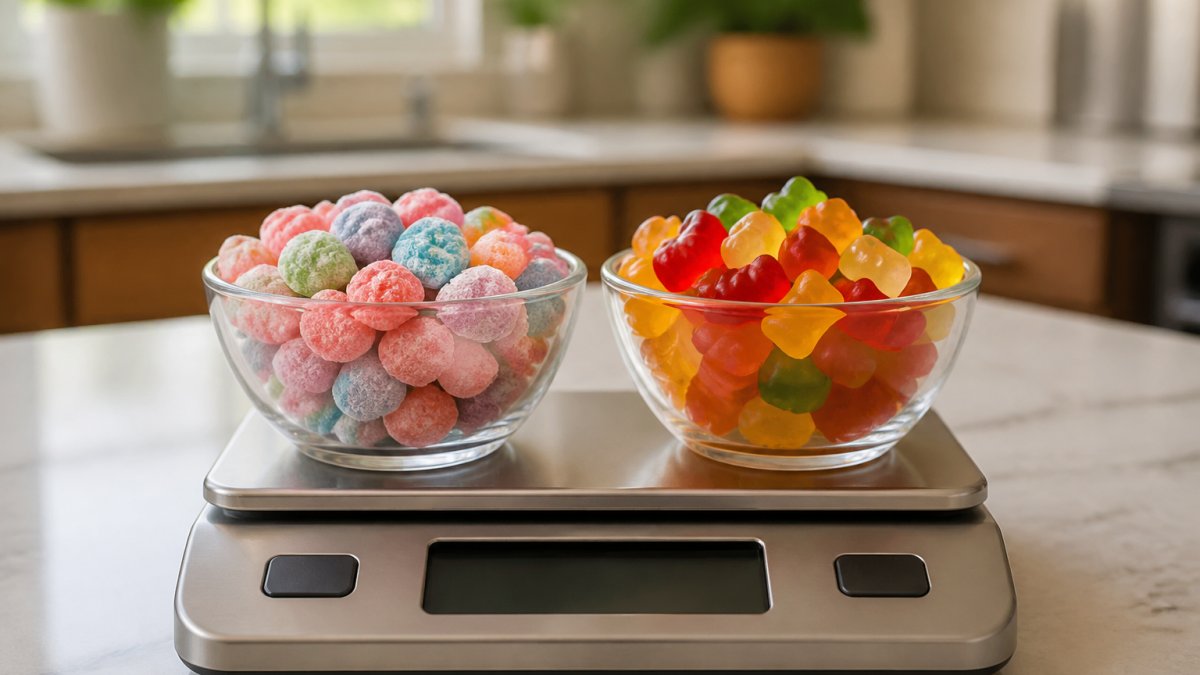
Here's the honest version. Take the same candy, one freeze-dried and one regular, and match them by weight. The sugar grams come out close to identical, because freeze-drying doesn't add or subtract sugar. What changes is volume and texture. The freeze-dried version takes up far more space for the same weight, so a handful looks like more candy than it is.
How to Run the Comparison Yourself
- Find the serving weight. On the Nutrition Facts panel, look at the serving size in grams (for example, "About 15 pieces (30g)"). This is the anchor for every number below it.
- Record total sugars and added sugars for that serving, in grams.
- Convert to per 100 grams so the two products share a basis: (sugar grams ÷ serving grams) × 100. This removes the water-weight difference from the equation.
- Convert to an equal-weight portion you'd actually eat, say 30 grams of each, using the same math.
- Compare the results side by side. If the recipes are the same, the per-100-gram sugar figure should land close to the original, because only water left the product.
A common pattern: the freeze-dried version's per-100-gram sugar number comes out at or slightly above the original, not below it. That's the water-loss effect, not a recipe change, the sugar didn't increase, the denominator shrank.
| Comparison Point | Freeze-Dried Candy | Regular Candy |
|---|---|---|
| Sugar per equal weight | Similar to original | Baseline |
| Sugar per 100 g | Can be higher (water removed) | Lower (water retained) |
| Water content | Removed | Retained |
| Texture | Crunchy, crispy | Chewy, soft |
| Weight per piece | Lighter | Heavier |
| Volume per serving | Larger | Smaller |
| Sugar per gram | Can be higher | Lower |
The table tells the story plainly. The freeze-dried column isn't a lower-sugar product. It's a lower-water product. If your goal is less sugar, switching to freeze-dried candy won't get you there on its own.
Freeze-Dried Candy Serving Size: Why Portion Matters More Than You Think
Portion size decides your actual sugar intake far more than the freeze-drying method does. Because freeze-dried candy is light, it's easy to eat more by weight without noticing: the label serving is defined by weight, but your hand measures by volume, and the two don't match after water is removed.
A serving of freeze-dried candy is defined by weight on the label, not by how full the bag looks. Anchor to that number. Eat straight from the bag and you're likely eating several servings, with the sugar adding up fast regardless of texture.
How Serving Size and Weight Affect Sugar Per Bag
A bag of freeze-dried candy can feel generous because the pieces are airy and the bag looks full. Weigh out one labeled serving and it may be a smaller pile than expected.
That's not a flaw in the product, it's how dehydration works. The same sugar that filled a dense chewy candy now fills a bigger, lighter space. So portion by the label, not by the handful. If you're sharing, split the bag into bowls rather than passing it around, and you'll keep servings honest.
A Worked Portion Example
Say a candy's Nutrition Facts panel lists a serving as 30 grams with 18 grams of total sugars. Picture two scenarios:
- Regular candy: 30 grams is roughly a small handful, a few dense, chewy pieces. You eat one serving and stop, because the candy feels substantial.
- Freeze-dried version: 30 grams is a much larger pile, because the water weight is gone. The same 18 grams of sugar is spread across more volume, so the pile looks like a light snack rather than a full serving. It's easy to eat two or three of those piles without registering the weight.
Eat three 30-gram portions of the freeze-dried version and you've taken in roughly 54 grams of sugar, three times the label serving, even though the bowl never looked heavy. The sugar per gram didn't change; the volume-to-weight mismatch did.
Practical Portioning Steps
- Use a kitchen scale for the first few servings so you can see what one label serving actually looks like in the bowl.
- Pre-portion into small bowls instead of eating from the bag, since the bag's light weight gives no feedback.
- Compare the serving weight, not the piece count. Freeze-dried pieces vary in size, so counting pieces is less reliable than weighing.
- Check how many servings the bag contains and divide accordingly if you're sharing.
Sugar Types and Ingredients: What's Actually in the Bag
The ingredient list of freeze dried candy tells you what kind of sugar you're eating, often more useful than the total. Freeze-drying doesn't change ingredients, it only removes water.
Look at the first ingredient. In most candy it's a sugar source: cane sugar, corn syrup, glucose, or a blend.
You'll also see sweeteners named individually, and sometimes sugar alcohols in sugar-free or reduced-sugar versions.
Some labels list net carbs, which subtracts fiber and sugar alcohols from total carbohydrates.
Freeze-Dried Fruit vs Freeze-Dried Candy: Not the Same Snack
Freeze-dried fruit and freeze-dried candy share a shelf and a texture, but they are not interchangeable nutritionally.
That difference shows up on the label. A bag of freeze-dried strawberries might list only fruit, with sugar appearing as a naturally occurring component.
So if you're choosing between the two for health reasons, freeze-dried fruit is the lighter pick on added sugar.
For snackers who want the candy experience with a cleaner ingredient list, freeze-dried fruit offers a middle path.
Common Misconceptions About Freeze-Dried Candy Sugar
Misconception one: freeze-drying makes candy healthier. It doesn't reduce sugar. It changes texture and weight, and that's it.
Misconception two: freeze-dried candy has fewer calories. Per gram, it can have more, because the water that added weight without calories is gone.
Misconception three: it's a good choice for low-sugar diets.
Misconception four: the crunchy texture means less sugar. Texture has nothing to do with sugar content.
The pattern behind all four is the same: people mistake a change in form for a change in nutrition.
Conclusion: What This Means for Your Snack Choices
The honest answer is that freeze-dried candy is not less sugary, and any product claiming otherwise deserves a close look at its label.
If you want the candy experience with a cleaner ingredient list, freeze-dried fruit is the better pick.
At Kelly's Pantry & Pawtry, we offer a range of freeze-dried candies and snacks built for flavor and crunch. Every product is crafted to deliver a bold, satisfying snacking experience. Browse the fan favorites and find your next craving.
FDA guidance on reading the Nutrition Facts label
USDA FoodData Central nutrition database
Dietary Guidelines for Americans on added sugars
Frequently Asked Questions
Does freeze-drying remove sugar from candy?
No. Freeze-drying removes water through a low-temperature dehydration process, but sugar molecules stay in the product. Because water makes up a large share of a candy's original weight, removing it means the remaining sugar is more concentrated by weight. A piece of freeze-dried candy can weigh a fraction of its original size while carrying nearly the same sugar content, which is why reading freeze-dried candy nutrition facts on the label matters.
Does freeze-dried candy have more sugar than regular candy?
Per gram of product, freeze-dried candy often shows higher sugar by weight because the water is gone. But per piece or per typical portion, the numbers are usually close to the original candy, since no sugar is added during freeze-drying. The real difference shows up in serving size: freeze-dried pieces are lighter, so a full serving may look larger than you expect. Always check the nutrition label for total sugars and servings per container.
How can I compare the sugar in freeze-dried and regular candy fairly?
Compare them by weight, not by volume. Weigh equal portions of each candy, then check the total sugars line on both nutrition labels per 100 grams. This removes the water-weight difference and gives you a true like-for-like comparison. Also note the serving size on each package, because a serving of freeze-dried candy may weigh far less than a serving of the regular version, which changes how much sugar you actually eat in one sitting.
Is freeze-dried candy a healthier alternative to regular candy?
Freeze-dried candy is not automatically healthier. It keeps the same sugar and calories as the candy it started as, minus the water. What it does offer is a lighter, crunchier texture and a longer shelf life without preservatives. If you are watching sugar intake, treat it like any candy: check the nutrition facts, watch your portion size, and enjoy it as an occasional treat rather than a daily snack.
Sugar content is one of the first things shoppers ask us about, and the label is the only reliable place to get the answer. Kelly's Pantry & Pawtry offers freeze-dried candies and snacks with clear ingredient lists, a range of freeze-dried fruit options, and the crunchy, flavor-packed texture that made these treats a favorite. Shop Kelly's Pantry & Pawtry to find the bag that fits how you snack.