

What Makes Freeze-Dried Candy Crunchy: The Science of Crunch
Table of Contents
- The Science Behind What Makes Freeze-Dried Candy Crunchy
- How Freeze-Dried Candy Is Made: A Step-by-Step Look
- Why Candy Expands When Freeze-Dried
- Freeze-Dried Candy vs Traditional Candy: Texture, Flavor, and Weight
- Why Results Vary: Troubleshooting Chewy or Soft Batches
- How to Store Freeze-Dried Candy to Keep It Crunchy
- Conclusion: The Crunch Comes Down to Moisture and Structure
- Frequently Asked Questions
Last Updated: October 9, 2026
The Science Behind What Makes Freeze-Dried Candy Crunchy
What makes freeze-dried candy crunchy comes down to one thing: nearly all the water is gone. A freeze dryer pulls that water out through sublimation, leaving a dry, airy structure that shatters when you bite it.
Freeze-dried candy has its water removed under a vacuum at low temperature, turning the ice inside straight into vapor and leaving a light, porous structure. That structure is the crunch.
The short version:
- Water inside the candy freezes into ice
- A vacuum pulls that ice into vapor without melting it
- The candy keeps its shape but loses its weight
The factors below explain why some batches crunch and others come out chewy.
Sublimation: How Ice Becomes Vapor Without Melting
Sublimation is the moment ice turns directly into vapor, skipping the liquid stage entirely. Most people picture melting: ice sits out, turns to water, then evaporates.
This matters because melting would ruin the candy. The USDA guide to freezing and food preservation explains how temperature and moisture affect food texture, and the same principles apply here.
Want to see it yourself? Watch a freeze dryer's clear chamber door during a cycle. You will see frost shrink and vanish without a single drip.
Air Pockets and the Porous Structure That Creates Snap
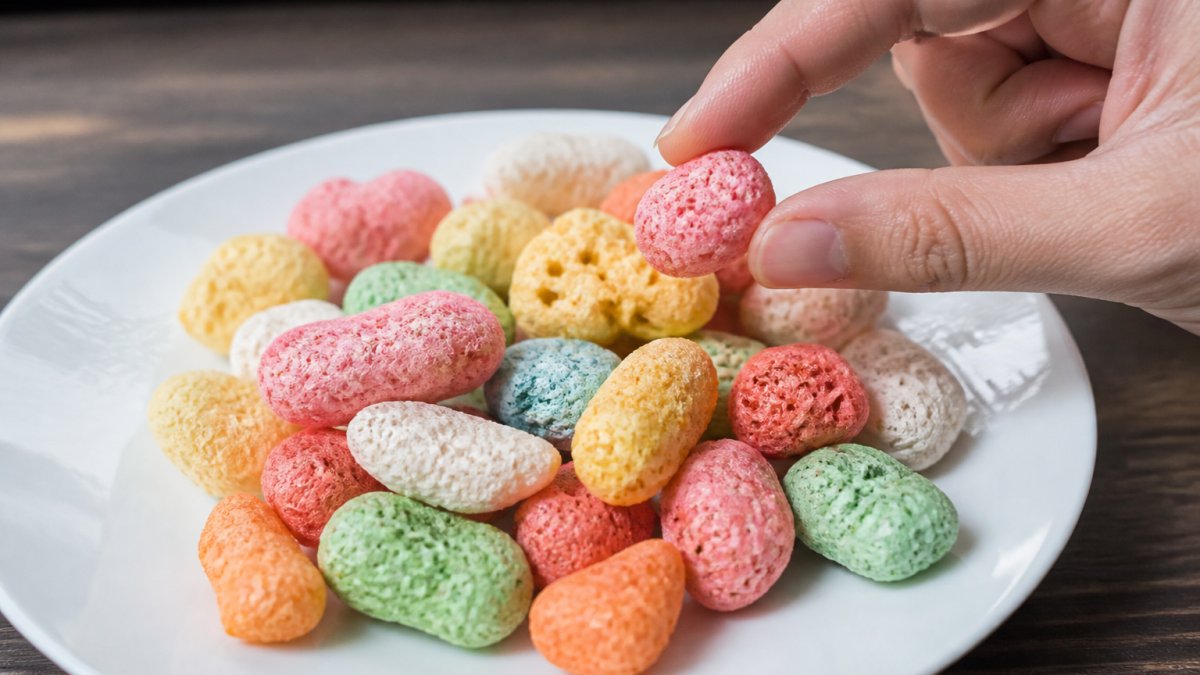
Porous structure is the network of tiny empty spaces left behind after the water leaves. Think of a sponge: light because it is mostly air held in place by thin walls. Freeze-dried candy works the same way.
When you bite in, those thin sugar walls collapse at once, that collapse is what your teeth and ears read as a snap.
How Freeze-Dried Candy Is Made: A Step-by-Step Look
Making freeze-dried candy is a controlled process, not a quick one. What separates a crunchy batch from a chewy one is not the recipe, it is how precisely you hit the freeze, vacuum, and drying targets:
- Spread the candy. Single layer on trays with a small gap so vapor can escape. Crowded pieces trap moisture and dry unevenly.
- Freeze it solid. Drop the candy well below freezing until all its water turns to ice, a common target is 0°F (-18°C) or colder, held until the center is frozen, not just the surface. A quick freeze keeps ice crystals small for a finer, more uniform pore structure.
- Pull a vacuum. Remove air from the chamber, lowering pressure below the point where ice can sublimate. Most home and small-batch dryers pull to a vacuum in the hundreds of millitorr range.
- Warm it slightly. Gentle heat gives the ice energy to sublimate without melting; the chamber stays cold enough that ice goes straight from solid to gas.
- Hold the cycle. This runs for hours, sometimes a full day, depending on batch size, candy type, and machine, the step most people rush.
- Check for dryness. The candy should feel light and brittle, with no soft spots. Crisp outside but dense or cool in the center means it is not done.
- Seal it fast. Airtight packaging right away, because the porous structure starts pulling humidity from the air the moment it is exposed.
The whole process takes several hours to more than a day. Rushing leaves water behind, and leftover water means a chewy bite.
Freezing, Vacuum, and the Drying Cycle
During the drying cycle, the freeze dryer holds low temperature and low pressure at the same time, that combination lets ice turn to vapor instead of melting.
A common mistake is pulling candy out too early: the outside feels crisp while the center still holds moisture, and that hidden water softens the whole piece over the next few days. If you are drying at home, add time rather than cutting it short.
Doneness Cues You Can Actually Measure
Vague instructions like "dry until done" are why batches vary. Use these cues instead:
- Weight loss: Weigh pieces before and after. Most candies lose a large share of their starting weight as water leaves. Barely any change means the cycle is not finished.
- Temperature: A fully dried piece comes out at or near chamber temperature, not cold. A cold center means ice is still sublimating.
- Feel: Rigid and snapping cleanly, not bending or feeling cool and dense.
Why Batch Results Vary
Even with the same candy and machine, two batches can turn out differently. The variables that matter most are recipe composition (sugar, water, and fat content), piece size and shape, pretreatment and storage, machine settings (temperature, pressure, cycle length), and load spacing. A crowded batch, larger pieces, or a humid day all need different handling, which is why measurable cues matter more than fixed timers.
Why Candy Expands When Freeze-Dried
Candy expands when freeze-dried because water takes up more room as a gas than as solid ice. As that vapor pushes outward, it stretches the sugar structure and puffs the piece up.
A gummy bear goes in small and comes out bigger, lighter, and full of tiny holes. The candy is not gaining anything, it is losing water and gaining air.
The flavor does not expand with it, though. The FDA guidance on food labeling and ingredients notes how water content affects a food's weight and how it is measured, which is why a smaller portion can still deliver full flavor.
Freeze-Dried Candy vs Traditional Candy: Texture, Flavor, and Weight
Freeze-dried candy vs traditional candy comes down to three differences: texture, flavor, and weight. The recipe may be the same, but the eating experience is not.
| Feature | Traditional Candy | Freeze-Dried Candy |
|---|---|---|
| Texture | Chewy or hard | Light and crunchy |
| Weight | Dense for its size | Very light |
| Flavor | Sweet, as made | More concentrated |
| Shelf life | Varies by type | Long when sealed |
| Best for | Everyday snacking | Novelty treats, gifting |
Traditional candy keeps its original texture: gummy stays chewy, hard candy stays hard. Freeze-dried candy trades that for a crispy, airy crunch.
Flavor is where freeze-dried candy surprises people: with the water gone, sweetness and fruit flavors hit harder.
Why Results Vary: Troubleshooting Chewy or Soft Batches
Results vary because candy is not all the same, and even two batches of the same candy can turn out differently. The fix is to diagnose the specific failure mode instead of guessing. Below, each symptom is tied to its likely cause and the adjustment that usually corrects it.
Chewy, Not Crunchy
The most common complaint. The cause is almost always residual moisture, but where it comes from matters:
- Cycle ended too early. The center still held ice. Fix: extend the drying cycle and use the doneness cues above (weight loss, temperature, snap test).
- Candy started too wet. Gummies and marshmallows hold a lot of water. Fix: expect longer cycles, and consider a longer freeze stage so the center is fully solid before vacuum is pulled.
- Pieces were too large. Thick pieces dry outside-in, leaving a wet core. Fix: cut or choose smaller pieces, or add cycle time.
Hard, Glassy, or Rock-Solid
Sometimes the opposite happens: the candy dries past a light crunch into a hard, glassy shard.
- Over-drying. Extra cycle time drives off the last traces of moisture and leaves a brittle, glass-like structure. Fix: stop at the doneness cues, not a fixed timer.
- Sugar composition. Candies high in certain sugars set harder when dried. Fix: blend or choose candies known to puff well, like marshmallows and gummies.
- Cool-down too fast. Rapid cooling stresses the structure. Fix: let the chamber come down gradually.
Collapsed or Deflated Pieces
If the candy puffs up and then sinks, the structure failed while it was still soft.
- Melted instead of sublimated. If chamber temperature climbed too high or pressure rose, ice melted and the sugar structure slumped. Fix: keep the chamber cold and the vacuum steady.
- Structural weakness. Some candies lack the body to hold a puff. Fix: choose candies with a firm set, or chill before the cycle.
- Handled while warm. Pieces moved before they cool can collapse under their own weight. Fix: let them cool fully before touching.
Sticky or Tacky After Drying
Sticky candy usually means sugar absorbed moisture from the air after the cycle.
- Weak seal or open air. The porous structure pulls humidity fast. Fix: seal immediately in airtight packaging, ideally with a desiccant.
- Humid environment. Drying or packaging on a humid day introduces moisture. Fix: work in a dry space and seal quickly.
- Incomplete dry. A damp core can feel tacky on the surface as moisture migrates out. Fix: extend the cycle.
Uneven Texture Across a Batch
Some pieces crunchy, some chewy, in the same batch.
- Stacked or crowded trays. Fix: single layer with space between pieces.
- Mixed piece sizes. Fix: sort by size or run separate batches.
- Hot or cold spots in the machine. Fix: rotate trays or run a smaller load.
Bland or Weak Flavor
Flavor is not a texture problem, but it shows up in the same troubleshooting conversation.
- Low-flavor base candy. Fix: start with a candy that already tastes strong.
- Over-dried. Pushing past full dryness can dull flavor along with texture. Fix: stop at the cues.
- Stale base candy. Candy that sat on the shelf too long starts with less flavor. Fix: use fresh candy.
Candy type matters most. Gummy candy, marshmallows, and hard candy freeze-dry well because they hold structure. Chocolate and anything high in fat or oil does not, because fat does not freeze and sublimate the way water does. Freeze-drying depends on moisture, time, and temperature, and all three shift from batch to batch.
How to Store Freeze-Dried Candy to Keep It Crunchy
The enemy of crunch is moisture, so storage is everything. Freeze-dried candy pulls water out of the air, so leave it exposed and it goes soft.
How to store freeze-dried candy so it stays crunchy:
- Move it into an airtight container or resealable bag right after opening
- Squeeze out extra air before sealing
- Keep it away from steam, sinks, and stovetops
Humidity is the real threat: a rainy day and an open bag are a bad pair. If your candy softens, you cannot fully bring the crunch back at home, the fix is prevention, not rescue.
If you want a steady supply that arrives crunchy and intact, our USPS packaging guidelines for shipping fragile items style of careful packing matters as much as the drying itself.
Conclusion: The Crunch Comes Down to Moisture and Structure
The crunch in freeze-dried candy is not magic. It is moisture removal plus structure.
The tricky part is keeping it that way. Soft batches come from leftover moisture, and soft candy comes from a weak seal. Get the drying cycle and the storage right, and the crunch holds.
That is exactly what we focus on at Kelly's Pantry & Pawtry. If you want a treat that stays crunchy from the first piece to the last, shop our fan favorites and taste the difference for yourself.
Frequently Asked Questions
What makes freeze-dried candy crunchy?
Freeze-dried candy gets its crunch from sublimation. During the freeze-drying process, ice inside the candy turns directly into vapor under a vacuum, leaving behind tiny air pockets. These air pockets create a porous, honeycomb-like structure that snaps easily when you bite into it. The removal of nearly all moisture (often 98-99%) means there is no water left to make the candy soft or chewy, so it stays crispy at room temperature.
Why does freeze-dried candy sometimes turn out chewy?
Chewy freeze-dried candy usually means the drying cycle was incomplete. If any moisture remains trapped inside, the candy will have a soft, leathery texture instead of a crunch. This can happen if the batch was too large, the vacuum was not strong enough, or the cycle ended too early. Humidity during packaging or storage can also rehydrate the candy, turning it chewy over time. Storing it in an airtight container with a desiccant pack helps prevent this.
Can I make freeze-dried candy in an air fryer?
No. An air fryer cannot freeze-dry candy because it does not create the vacuum or low-temperature conditions needed for sublimation. Air fryers use hot air to cook food, which would melt or burn candy rather than remove ice. True freeze-drying requires a freeze dryer that first freezes the candy, then pulls a vacuum to turn ice directly into vapor. Without that equipment, you cannot achieve the same light, crunchy texture.
How should I store freeze-dried candy to keep it crunchy?
Store freeze-dried candy in an airtight container or mylar bag with a oxygen absorber or desiccant pack. Keep it away from humidity, direct sunlight, and heat. Once the package is opened, reseal it tightly or transfer leftovers to a mason jar with a lid. If left exposed to air, the candy will absorb moisture and lose its crunch within hours. Properly stored, it can stay crispy for weeks or even months.