

Why Freeze-Dried Candy Tastes So Intense
Table of Contents
- Why Freeze-Dried Candy Tastes Intense: The Short Answer
- How Freeze-Drying Changes Candy Texture
- Does Freeze Drying Make Candy Sweeter?
- Freeze-Dried Candy vs Regular Candy: What's Different
- Best Candy to Freeze Dry (and Which Ones Disappoint)
- Why Some Freeze-Dried Candy Tastes Bland or Stale
- Conclusion: What Makes Freeze-Dried Candy Worth Trying
- Frequently Asked Questions
Last Updated: October 4, 2026
Why Freeze-Dried Candy Tastes Intense: The Short Answer
Freeze-dried candy tastes intense because removing nearly all its water concentrates the sugars, acids, and aroma compounds that create flavor. That is the short answer, and it is the one most guides stop at.
Water makes up a huge share of a gummy or chewy candy's weight. Pull that water out, and what remains is a lightweight, porous version of the original.
But concentration alone does not explain why freeze-dried candy tastes intense in a way that feels almost aggressive. Two other forces are at work: the physical structure of the candy, and the way your mouth breaks it down.
How Water Removal Concentrates Flavor
Water is a solvent. It carries dissolved sugars, acids, and aromatic compounds, and it keeps them spread out and diluted. When a freeze-dryer pulls water out through sublimation, going straight from ice to vapor without a liquid stage, those dissolved solids stay behind. The candy keeps its shape, but its mass drops sharply.
The result is flavor density. A piece that once weighed several grams now weighs a fraction of that, yet it holds roughly the same load of sugar and acid. Bite for bite, you are getting more flavor per gram. That is the mechanical part of the story, and it is real.
How the Porous Structure Changes Flavor Release
Here is where most explanations get lazy. Freeze-drying leaves behind a network of tiny air pockets where the ice crystals used to be. That porous structure does two things at once: it makes the candy shatter instead of resist, and it gives your saliva far more surface area to work on.
Flavor release is a function of how fast a candy dissolves and how quickly its aroma compounds reach your nose. A dense gummy releases sugar slowly. A porous freeze-dried piece essentially collapses on contact, dumping its full flavor load in the first few seconds. That burst is what your brain reads as intensity.
How Freeze-Drying Changes Candy Texture
Texture is the headline change, and it drives perceived flavor as much as chemistry does. That transformation is why freeze-dried candy tastes intense: the mouthfeel accelerates flavor release instead of pacing it out.
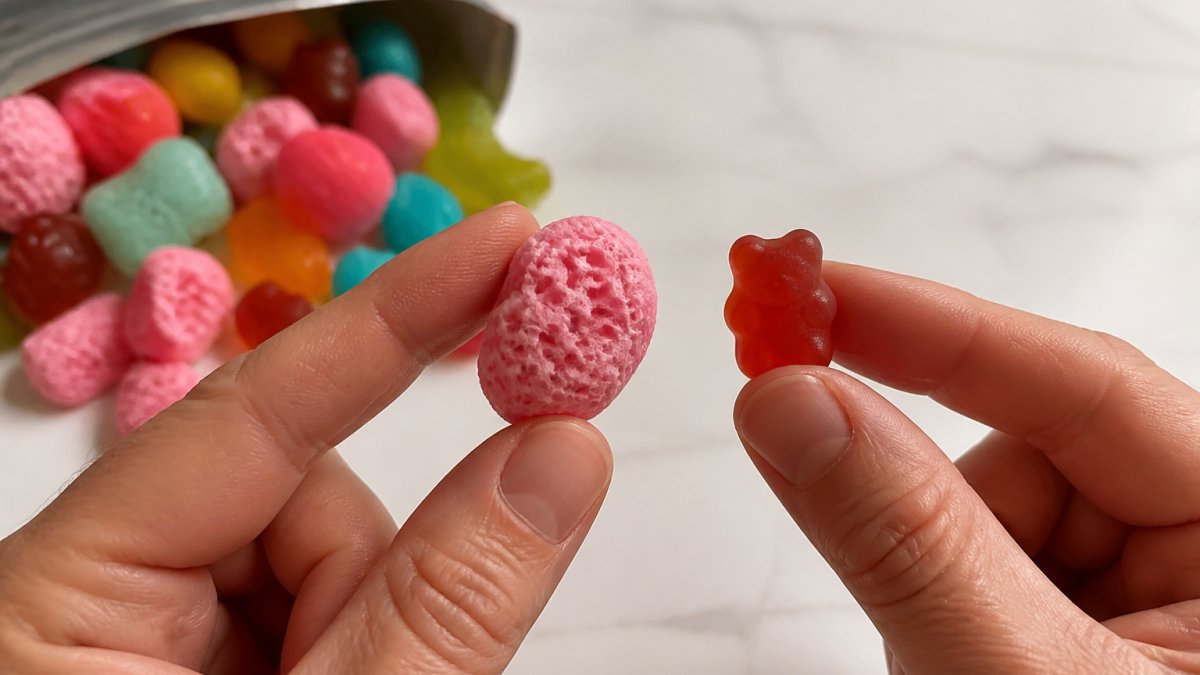
Think about how long a gummy bear lasts in your mouth. You chew it, and it slowly gives up its sugar over twenty or thirty seconds.
That compression is the whole trick. Your taste buds and olfactory receptors respond to rate as much as to quantity. A slow drip of sugar reads as mild. A sudden flood reads as bold.
Does Freeze Drying Make Candy Sweeter?
Not exactly. Freeze-drying does not add sugar or change a candy's recipe, so the total sweetness is essentially the same as the original. What changes is how fast you perceive it. The candy tastes sweeter because the sugar hits your palate all at once, not because there is more of it.
This is the distinction almost every article blurs. Perception is not the same as composition. A freeze-dried fruit chew and its regular counterpart contain the same sugar by weight. Eat equal weights of each, and you get the same sugar. But nobody eats freeze-dried candy by weight.
Sweetness, Sourness, and What Actually Changes
Sourness behaves differently than sweetness. Sour candy relies on acids, and acids need moisture to register sharply on the tongue. Because freeze-dried candy dissolves so fast, the acid is released quickly too, which can make a sour gummy taste sharper and more bracing than the chewy original.
Some people find the sourness almost too aggressive. Others find it is the best version of the candy they have had. Both reactions are honest; the difference comes down to how much acid the specific candy carries and how fast it dissolves.
Freeze-Dried Candy vs Regular Candy: What's Different
The core difference is water content and structure, and everything else follows from those two factors. Regular candy holds water, stays dense, and releases flavor slowly. Freeze-dried candy holds almost none, shatters easily, and releases flavor fast.
| Attribute | Regular Candy | Freeze-Dried Candy |
|---|---|---|
| Water content | High | Near zero |
| Texture | Chewy or dense | Crunchy and porous |
| Flavor release | Slow, gradual | Fast, immediate |
| Mouthfeel | Sticky, long-lasting | Light, melts quickly |
| Perceived intensity | Mild | Bold |
That table is the practical summary. If you want a candy that lingers, regular wins. If you want a candy that delivers a punch in the first second, freeze-dried wins.
Best Candy to Freeze Dry (and Which Ones Disappoint)
Not every candy survives the process the same way, and the reason comes down to two variables: how much water the candy holds, and what structure that water leaves behind when it leaves. A candy that is mostly sugar and water will puff into a porous, fast-dissolving shard. A candy that is mostly fat or already crystalline has little water to remove, so there is no structure to transform and no flavor-release boost to gain.
That is why the same process produces outstanding results on one candy and chalky disappointment on another. Here is how the major categories actually behave, and why.
Chewy fruit candy, taffy, and fruit chews
These are the strongest candidates. They carry a high water load and a soft, sugar-acid matrix, so sublimation leaves behind a rigid, airy lattice packed with the same sugar and acid the original held. The result is a candy that shatters instead of stretches and dumps its flavor in the first few seconds.
A common pattern is that fruit chews come out tasting louder and more aromatic than the chewy original, because the aroma compounds that were trapped in a slow-dissolving matrix are now released almost instantly. The trade-off: any off-note in the source candy, a slightly stale oil, a weak fruit top note, is also amplified.
Sour gummies and coated sour candy
Sour candy is where the perception shift is most dramatic, and not always in a good way. Sourness depends on acids like citric and malic acid registering on the tongue, and those acids need moisture to dissolve and reach the taste buds.
Some tasters love this, it reads as bracing and clean. Others find it harsh or unbalanced, because the sour note now arrives before the sweetness has a chance to round it out. If a sour candy tastes overly aggressive after freeze-drying, that is usually the acid-to-sugar release timing, not a change in the recipe.
Gummy bears and gelatin-based gummies
Gelatin gummies generally do well. They hold enough water to puff, they keep their color, and the gelatin network leaves a crisp, glassy structure. The flavor usually stays recognizable, though the texture becomes closer to a light cracker than a chew.
One exception worth knowing: gummies with a heavy wax or oil coating can behave inconsistently, because the coating does not dry the same way the interior does and can leave a slightly greasy or dull surface.
Marshmallows
Marshmallows are a special case. They are already mostly air, so freeze-drying them produces a very light, crisp, almost meringue-like piece. Flavor intensity does not jump the way it does with a gummy, because there was not much water or flavor load to concentrate in the first place. What changes is texture and how fast the sugar dissolves, the piece feels lighter and melts faster, but it does not suddenly taste bolder.
Hard candy and lollipops
Hard candy is mixed. It has very little water, so there is little to remove and little structural change. Some hard candies crack unpredictably during processing, and some lose the clean, slow dissolve that made them pleasant. The flavor does not concentrate much because there was not much water diluting it to begin with.
Chocolate, caramel, and fat-based candy
These are the most common disappointments, and the reason is structural. Chocolate and caramel are fat-based or low-moisture, so there is no water to sublimate and no porous network to build. Instead of puffing, they tend to turn chalky, grainy, or crumbly, and the fat can separate in ways that dull the flavor rather than sharpen it.
A caramel with a high water content can sometimes work, but the result is unpredictable. The general rule: the more a candy depends on fat for its appeal, the less freeze-drying has to offer it.
Why Some Freeze-Dried Candy Tastes Bland or Stale
Bland freeze-dried candy is almost always a process problem, not a flavor problem. If the candy was not fully dried, or if it absorbed moisture after packaging, it loses the crunch and the fast flavor release that make the format work. What is left tastes flat and oddly hollow.
Three things cause most disappointments:
- Incomplete drying. Residual moisture keeps the candy dense, so it never develops the porous structure that drives flavor release.
- Moisture reabsorption. Freeze-dried candy is hygroscopic, meaning it pulls water from the air. A bag left open goes soft and dull within hours.
- Poor source candy. Freeze-drying concentrates whatever flavor is there. If the original candy was weak, the freeze-dried version is just a louder weak candy.
Storage matters more than most people expect. Keep freeze-dried candy sealed and away from humidity, and it holds its crunch and flavor far longer.
Conclusion: What Makes Freeze-Dried Candy Worth Trying
The intensity you taste is not a gimmick and it is not added flavoring. It is the natural result of removing water, building a porous structure, and letting your mouth release everything at once. Once you understand that, the whole format makes sense, including why some pieces shine and others fall flat.
If you want to taste the difference for yourself, the fan favorites at Kelly's Pantry & Pawtry are built around exactly this: carefully crafted freeze-dried candies that deliver a bold, crunchy, flavor-packed experience.
Frequently Asked Questions
Why does freeze-dried candy taste more intense than regular candy?
Freeze-dried candy tastes more intense because the freeze-drying process removes nearly all the water from the candy. With less water diluting the sugars, acids, and aroma compounds, each bite delivers a more concentrated hit of flavor. The candy also becomes porous and crunchy, so it dissolves quickly on your tongue and releases those flavor compounds all at once instead of slowly over several chews.
Does freeze drying make candy sweeter?
Freeze-drying doesn't add sugar, but it can make candy seem sweeter. Removing water concentrates the natural sugars already in the candy, and the airy, fast-dissolving texture spreads them across your taste buds more quickly. Sour notes can feel sharper too. The result is a stronger overall taste, not necessarily more sugar. Some people find very tart candies become almost overwhelming after freeze-drying for this reason.
What is the best candy to freeze dry?
Fruit chews, gummy bears, sour gummies, and taffy-style candies tend to freeze-dry best. They hold their shape, puff up nicely, and develop that signature crunchy, airy texture. Hard candies and chocolates are trickier: hard candy can shatter, and chocolate doesn't freeze-dry well because of its fat content. Small, chewy candies with strong fruit flavors usually give the most dramatic and satisfying results.
Is freeze-dried candy bad for you?
Freeze-dried candy is still candy. It has roughly the same sugar and calorie content per piece as the original version, just without the water weight. It isn't a health food, and it isn't lower in sugar. That said, the process doesn't add artificial ingredients or preservatives, so the ingredient list stays similar to the original candy. Treat it as an occasional snack, the same way you would regular candy.
Freeze-dried candy rewards a little curiosity. The same flavors you grew up with come back louder, crunchier, and faster. If you are ready to find your favorite, browse the fan favorites at Kelly's Pantry & Pawtry and taste the difference a little water removal makes.